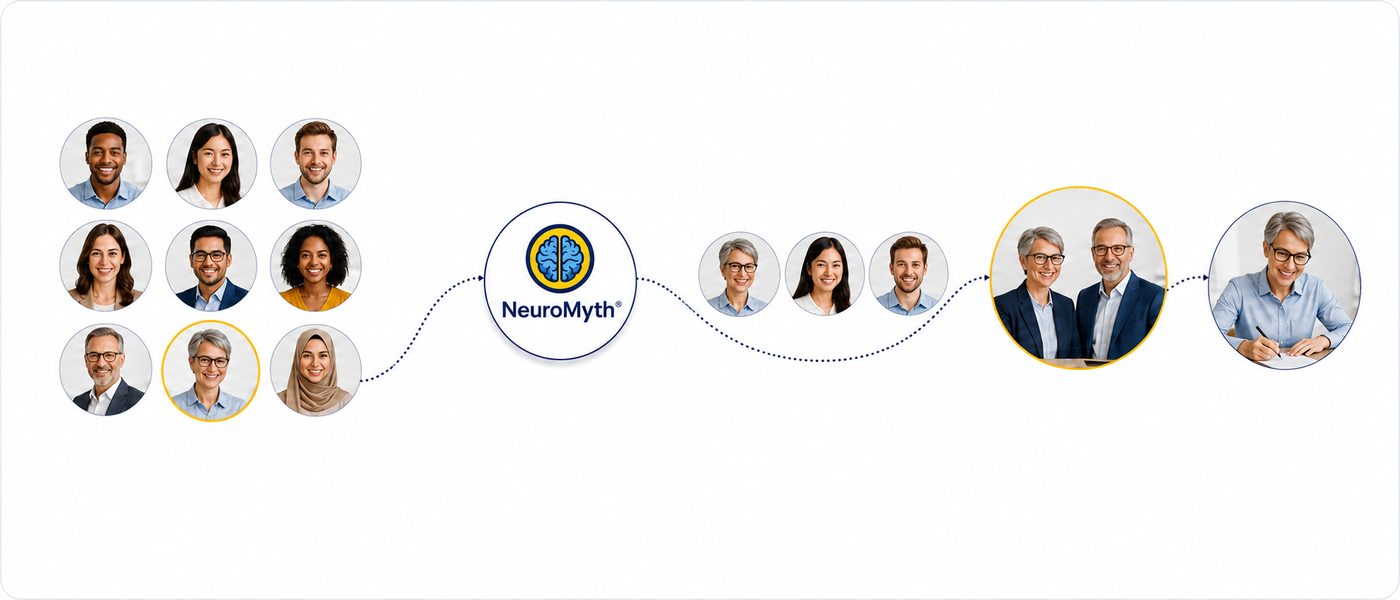
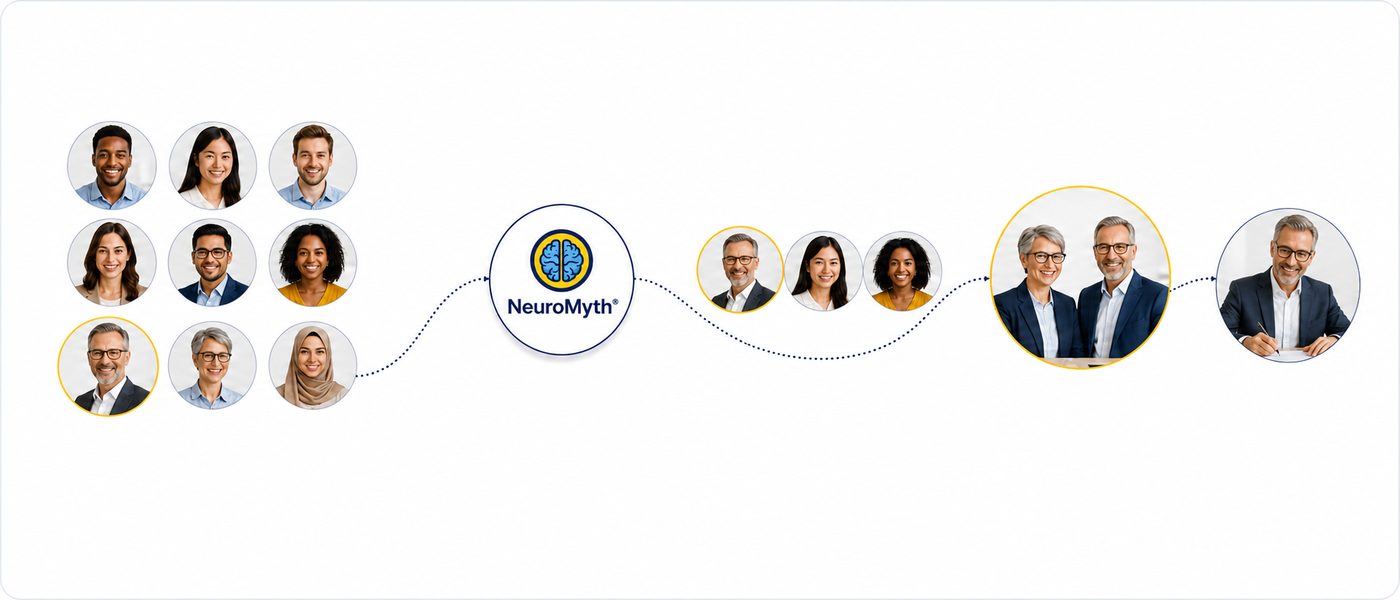
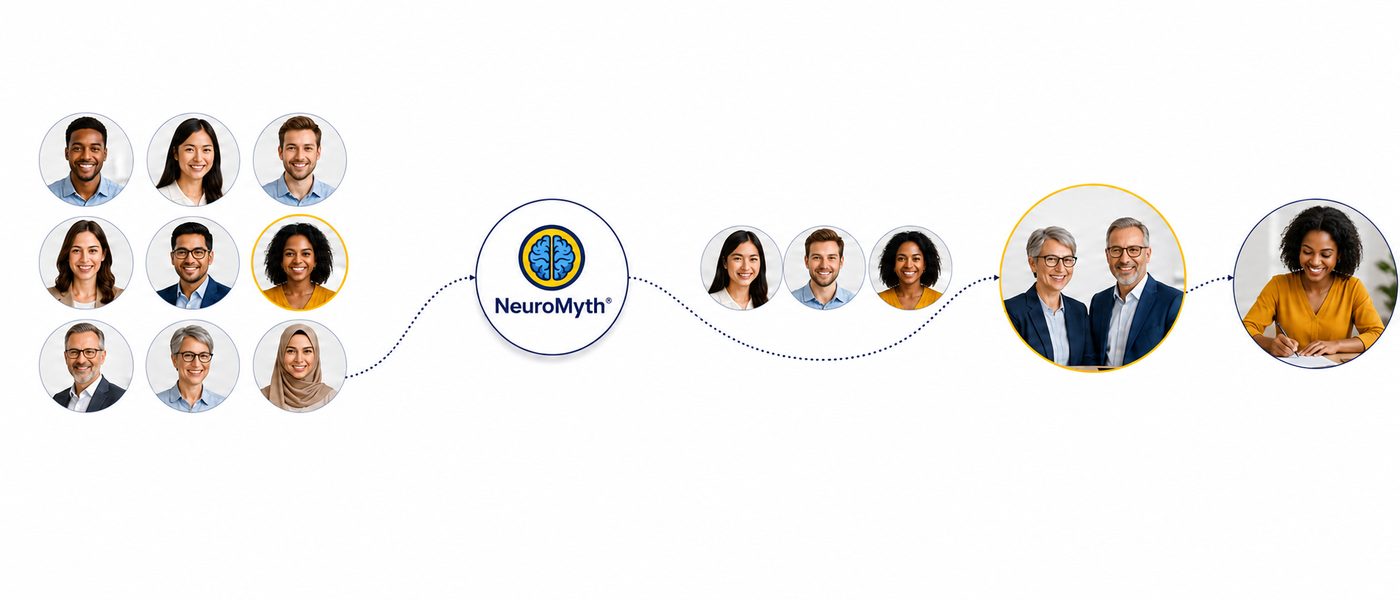
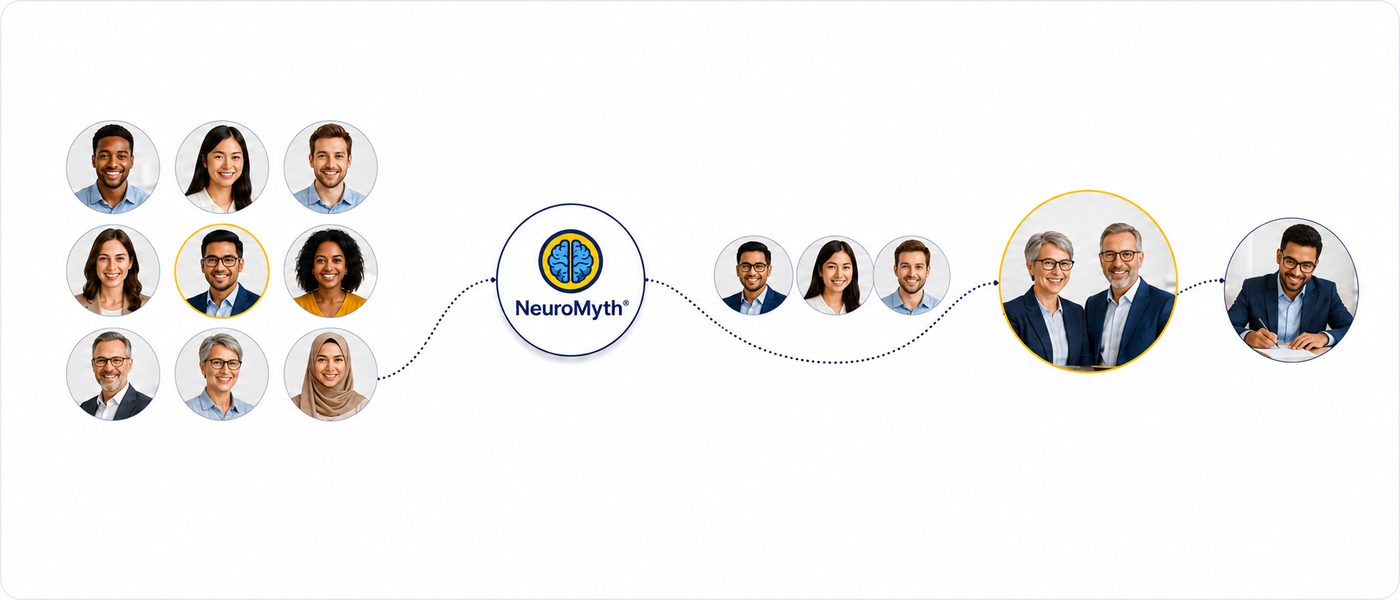
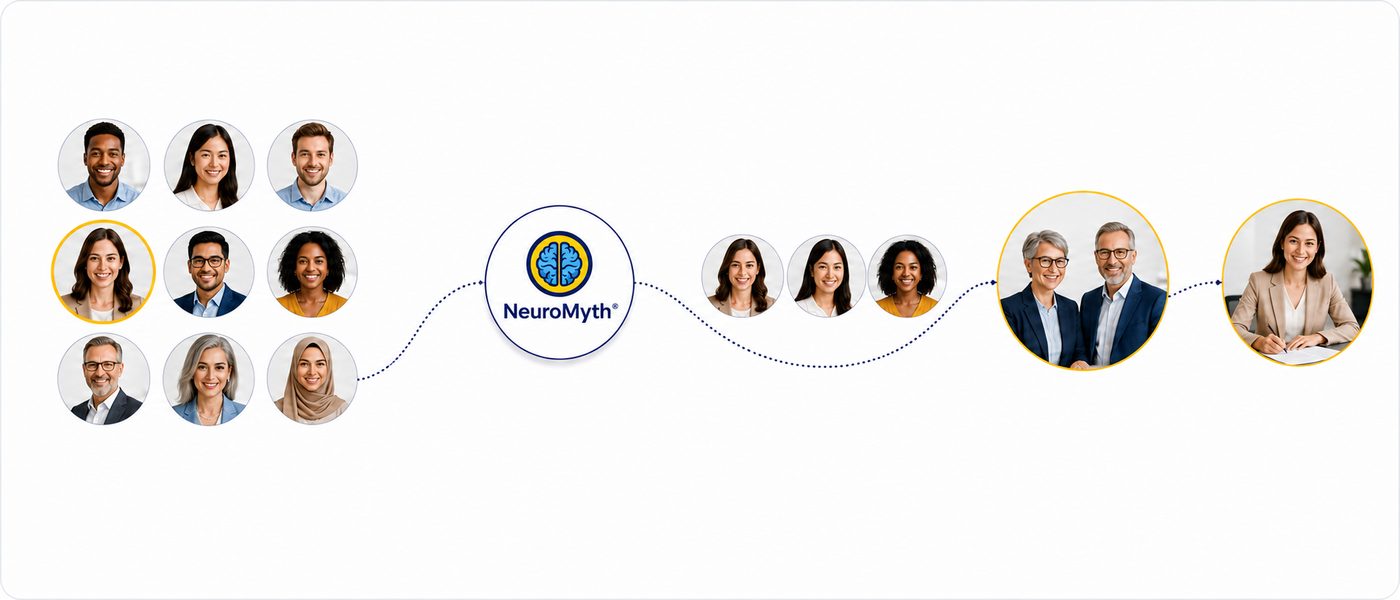
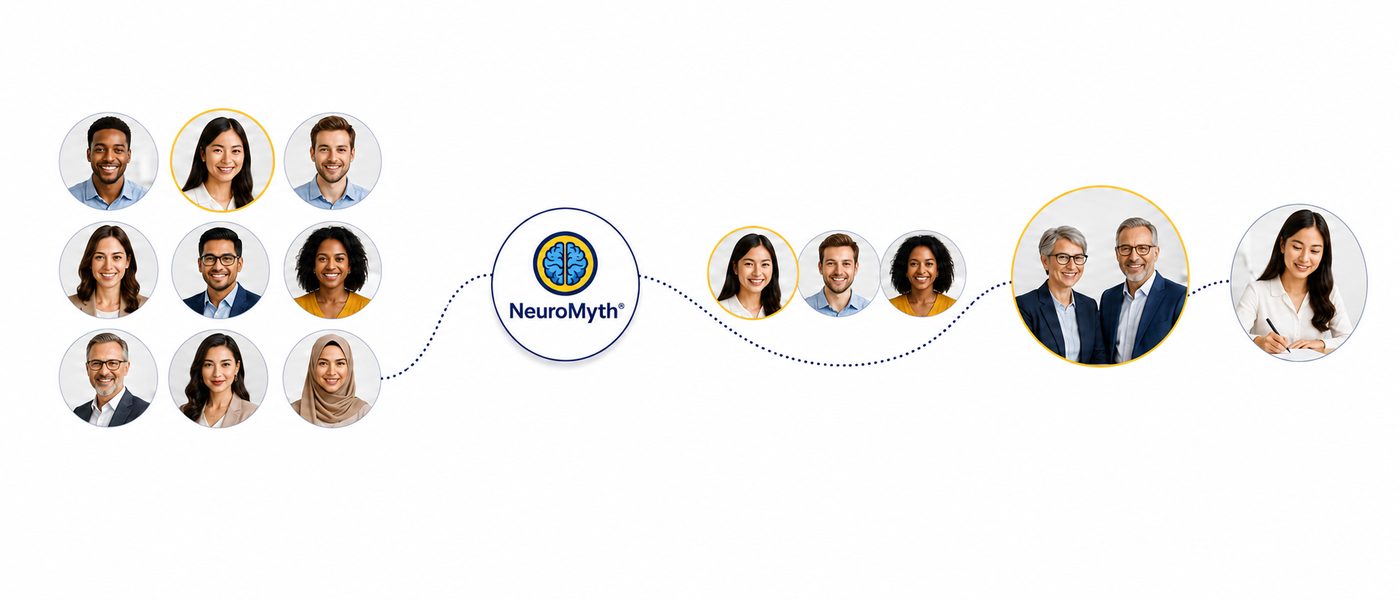
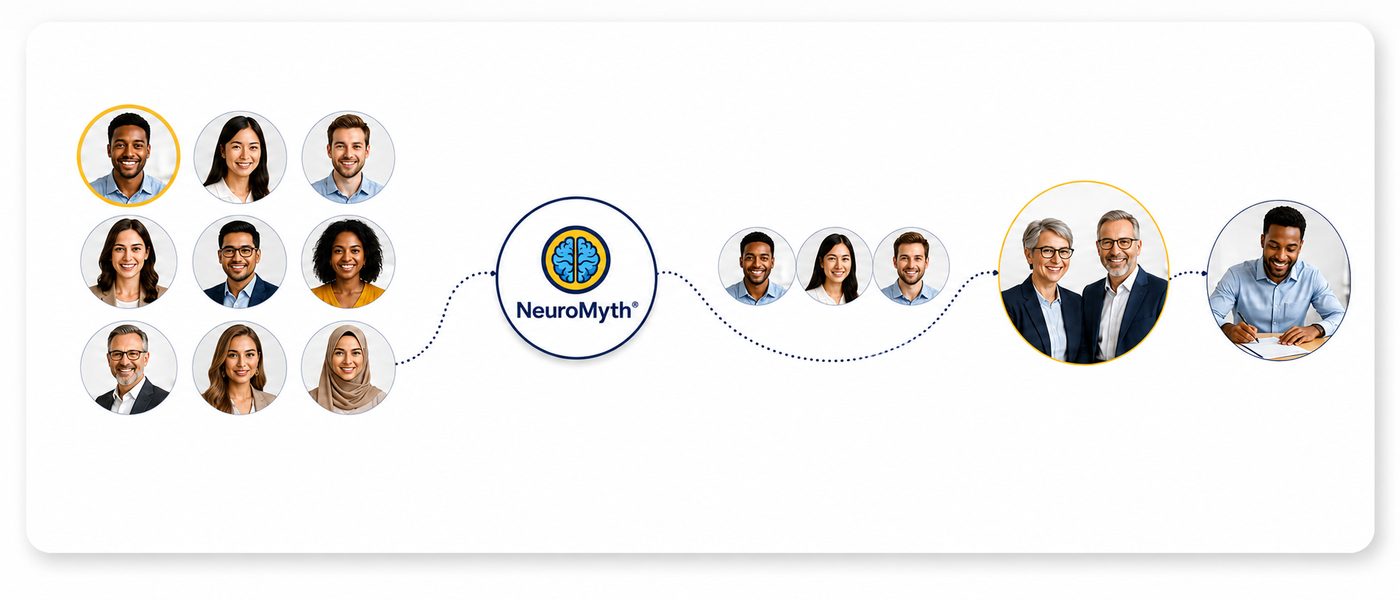
Shortlists that look identical on paper. Candidates who interview brilliantly and underperform on the job. NeuroMyth adds one uncoachable layer — the structure of how a person thinks — before the first conversation.
Coaching, AI-generated answers, polished interviews — the standard assessment stack was not built for 2026.
A well-formatted CV signals effort in presentation, not capability in role. When twenty candidates have the right experience and the right keywords, the CV stops being a filter.
The best interview performers are rarely the best job performers. Structured interviews measure verbal fluency and preparation — both are coachable. Neither predicts decision behaviour under real pressure.
Candidates research them online the evening before. Conscious self-reporting under evaluation pressure tells you how someone wants to be seen — not how they behave when it matters.
Written assessments, take-home tasks, even motivational letters — all now coachable with a prompt. The signal you thought you had has already been compromised for a large portion of your applicant pool.
When recruiters are processing fifty candidates, evaluation quality degrades — not from lack of skill, but from fatigue and the absence of a consistent, structured signal to compare against.
Assessment centres take days. Reference checks take weeks. The best candidates accept competing offers before your process produces a decision. Speed and quality pull in opposite directions — until now.
The candidate writes a short story — on paper, no device. They have no idea what's being measured. The patterns in how they build that story are structural, stable, and tell you more about how they'll behave in the role than anything else in your process.
Thirty minutes, paper and pen, no instructions beyond "write a story." No device. No internet. No way to prepare or generate an AI-assisted answer. The story is genuinely theirs.
Tamper-proofThe engine processes the structural patterns in the narrative — agency, causality, conflict handling, role in uncertainty — and generates the report output. The content of the story is not what's measured.
UncoachableA human analyst reviews every output before delivery. No report leaves without this step. You receive a structured, actionable document within 2–3 hours of submission — ready to support your next conversation.
Human-in-the-loopFour report levels, same assessment. Add depth without re-administering.
Executive summary, behavioural indicators, and traffic-light signals. Designed for volume: screen twenty candidates quickly and surface the profiles worth a deeper look. Ideal for first-round decisions.
Everything in SCR plus strengths, attention areas, and a role-fit matrix. When you've narrowed to five candidates and need structured evidence for the hiring manager, FIT gives you the language to defend the choice.
Decision style, stress management, micro-symbols, and predictive correlations. For roles where the cost of a wrong hire exceeds the cost of a thorough process. Use EXE when the hire changes something.
All four levels combined. Leadership style, motivational vectors, shadow risks, and profile-role context. Reserved for C-level, board, or strategic positions where behavioural depth is non-negotiable.
The standard CV-plus-interview process would take four weeks and introduce significant inconsistency across the three regions — different interviewers, different implicit criteria, different results. The team decides to use NeuroMyth SCR on the top twenty profiles after CV review.
Candidates receive the paper test via the regional office during a standardised 30-minute session. No briefing beyond the instruction card. Submissions are photographed and uploaded. Reports arrive within three hours.
The SCR traffic-light output allows the team to cluster the twenty into three groups: profiles with strong proactive-agency indicators (flagged for immediate interview), profiles with significant attention areas (set aside), and a middle group warranting a second look. The shortlist is built in half a day, not three weeks.
Two candidates from the "attention areas" group — who had the most polished CVs — show a passive-reactive pattern across every narrative indicator. They would have been strong interview performers. The SCR data gives the team the language to explain and document the decision.
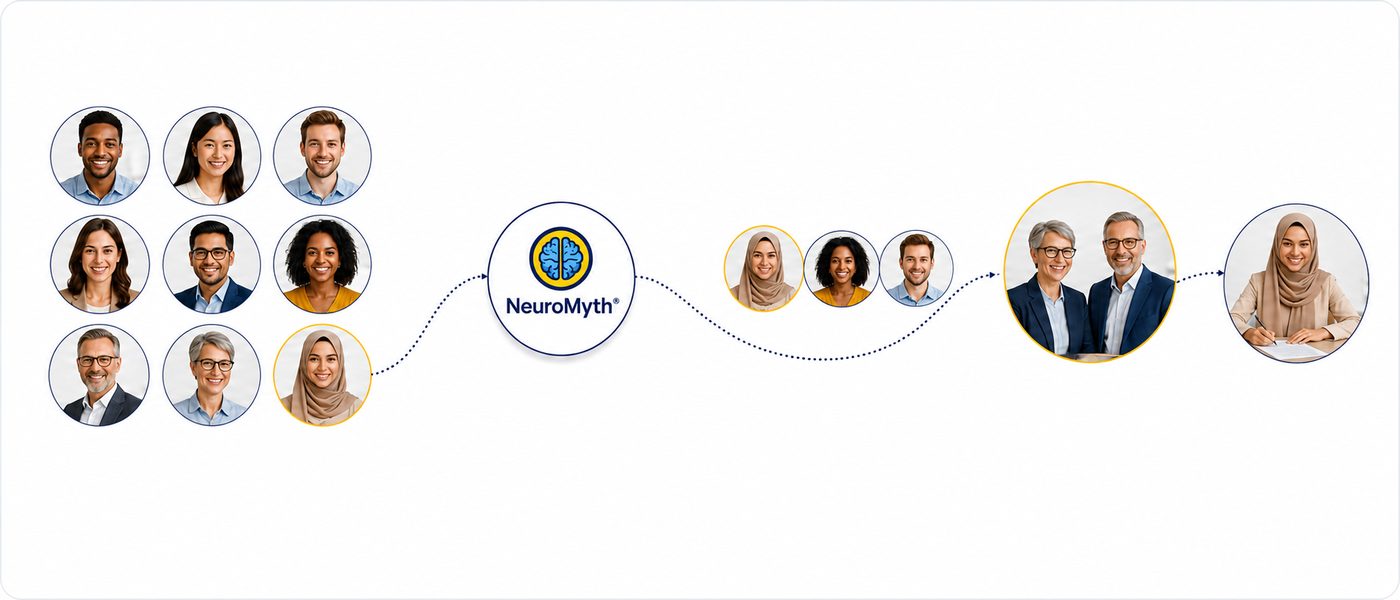
Handwriting, spelling, vocabulary, cultural references: none of these are measured. None of them predict decision behaviour. All of them carry bias. NeuroMyth reads structure — not style, not background, not presentation.
Understand how a new hire will interact with an existing team before the contract is signed. Compare profiles, map complementarity, identify friction points.
For roles where the cost of a wrong hire is significant. EXE and ELI depth levels surface decision style, shadow risks, and stress patterns that interviews never reach.
Build a leadership team with complementary profiles. Understand the motivational vectors that will shape your organisation's culture before they do.
Same system. Same human reviewer. Same output as paying clients. Use all five before deciding anything — no sales call required.
Get 5 Free TRY →