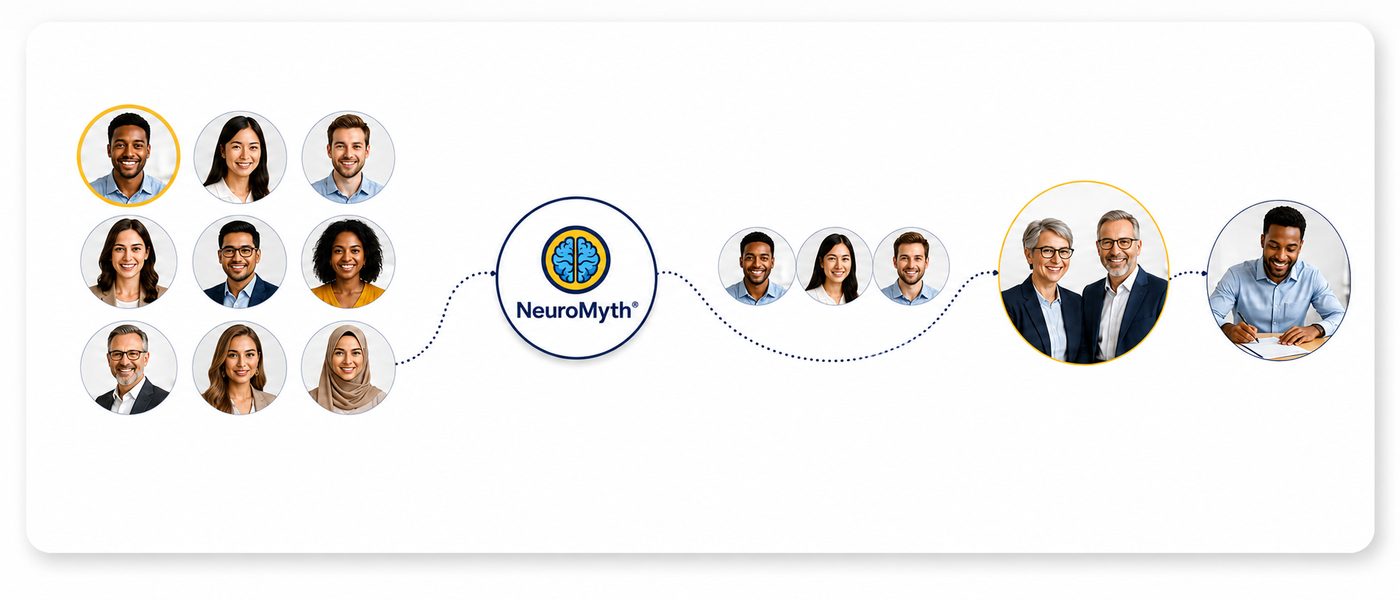
For each NM code, pick the route that fits.
When you activate your codes, you receive one email containing, for every candidate, a printable PDF and a unique online link. Same method, two delivery options — you choose per candidate.
Print & run the Laboratory
Print the PDF (it carries the candidate’s NM code and QR), hand over the sheet and a pen, set 30 minutes. No screen, no internet.
- Protected & authentic — with no device in reach, the story can’t be optimised, searched or generated by AI
- The candidate writes by hand, calmly
- You photograph or type the sheet and submit
- Best signal quality
Send the unique link
From the same email, send the candidate their unique link (it already carries their NM code) — to their phone, or open it on a dedicated company test PC. They complete it in a dedicated online page.
- Before writing, the candidate accepts privacy & GDPR, agrees not to write names, and is informed that AI is used
- The story is written directly on the page
- Fast for remote or last-minute cases
- Less protected than paper: a device is involved

Why we recommend paper: it can’t be faked with AI.
Any online questionnaire can now be completed with an AI assistant in the next tab — so you no longer know whose answers you are reading. The paper Laboratory removes the screen entirely: the candidate writes by hand, in the room, in 30 minutes. What you receive is genuinely theirs. The online link stays available for speed, but when authenticity matters most, paper is the protected choice.