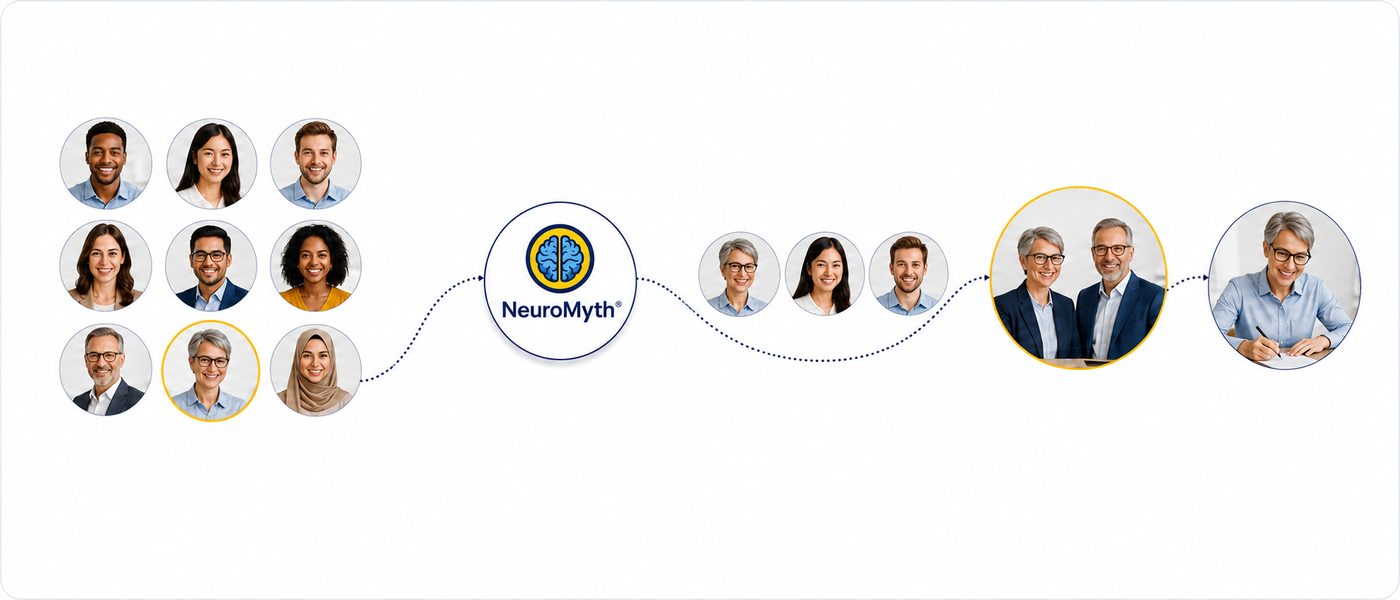
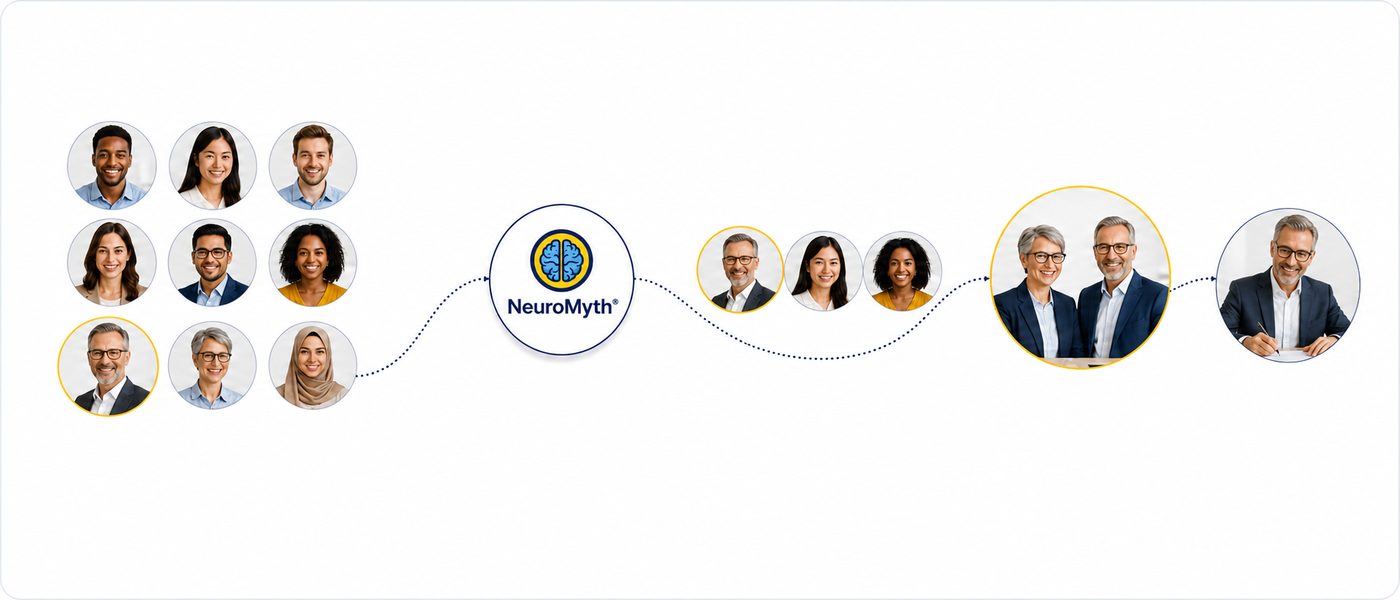
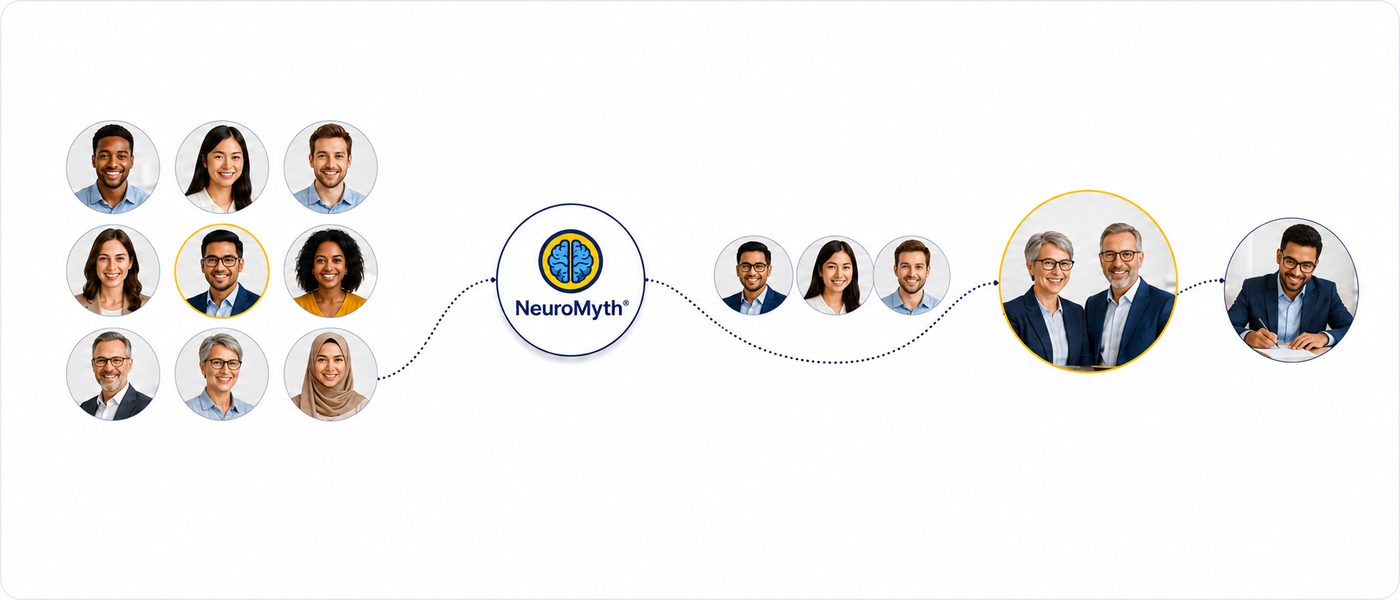
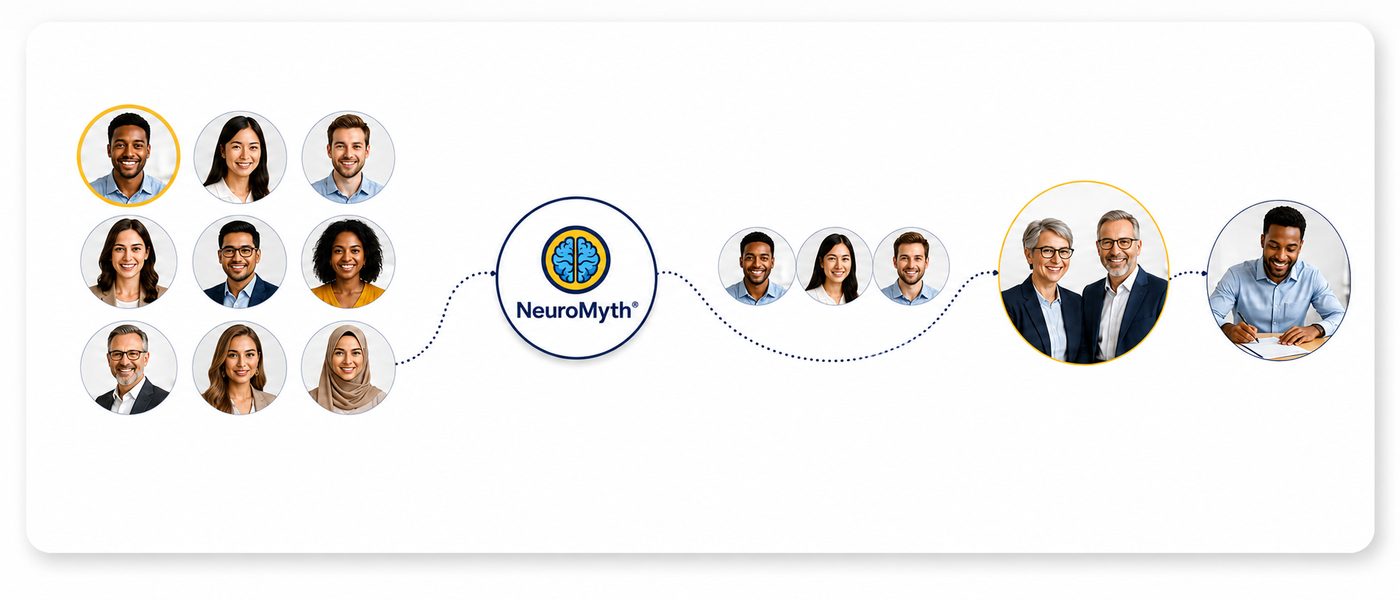
The most common cause of a failed hire isn't a lack of competence. It's a mismatch between how someone processes decisions and how the team around them already works. NeuroMyth maps that gap before it becomes a problem.
Behavioral mismatches are invisible until they surface as conflict, disengagement, or underperformance.
Teams discuss cultural fit without a common language for what that means. Gut instinct in the final interview stage is not a methodology — it's a liability. It introduces the biases the rest of the process tried to remove.
Competence is portable. Behavioral patterns are not context-neutral. A candidate who thrived in a directive, hierarchical structure may struggle in a flat team that runs on peer negotiation — regardless of their track record.
Two profiles with complementary skills but identical decision styles. Both proactive, both directive, both accustomed to taking ownership. Nobody maps this in the hiring process — it shows up six months later in every meeting.
NeuroMyth gives HR managers a structured, documented behavioral baseline for both the incoming candidate and the existing team. The FIT report shows not just whether someone is qualified — but whether they are likely to function well in this specific context.
The candidate writes a free story in 30 minutes — on paper, no device. No coaching guide can prepare for a prompt that asks for nothing specific and measures how the story is built, not what happens in it.
UncoachableThe FIT report includes strengths, attention areas, and a role-fit matrix designed to translate behavioral patterns into hiring language. You receive structured evidence to defend — or question — the choice.
Role-fit matrixIf key team members have been assessed, the analyst review includes a comparative note on behavioral complementarity — identifying where the new profile adds balance and where friction risk is elevated.
Team mappingThe FIT report translates narrative pattern signals into four hiring-relevant dimensions.
Behavioral patterns that are likely to function well in the specific role and team context — not generic strengths, but structural tendencies that align with what the position actually requires.
Patterns that may need active management, mentoring, or structural support. Not disqualifying signals — context for onboarding decisions and early management focus. Documented before the hire, not discovered after.
A direct mapping between the candidate's behavioral profile and the specific demands of the role. Gives the HR manager a language for the recommendation — structured evidence, not impression.
Where existing team profiles are available, the analyst review includes a note on how the candidate's pattern sits alongside the team's dominant behavioral tendencies — balance, overlap, or friction risk.
Both candidates receive the NeuroMyth assessment. Both undergo FIT-level analysis. The team lead and two senior team members were assessed twelve months prior as part of an earlier process — their profiles are on file.
The FIT report for Candidate A shows a strongly proactive-directive pattern — the same pattern that characterizes three of the five existing team members. The role-fit matrix rates the candidate highly for individual performance but flags an elevated attention area around peer-negotiation in ambiguous situations.
Candidate B shows a complementary profile: proactive but adaptive, with structural indicators of strong lateral communication and comfort in under-specified contexts. The role-fit matrix is slightly lower on individual output metrics, but the analyst note flags this profile as a better fit for the specific team composition.
HR uses the FIT reports as the basis for a structured recommendation to the sales director — not "we prefer Candidate B," but "here is the documented behavioral evidence for why Candidate B reduces the team's existing friction risk while Candidate A would likely reinforce it."
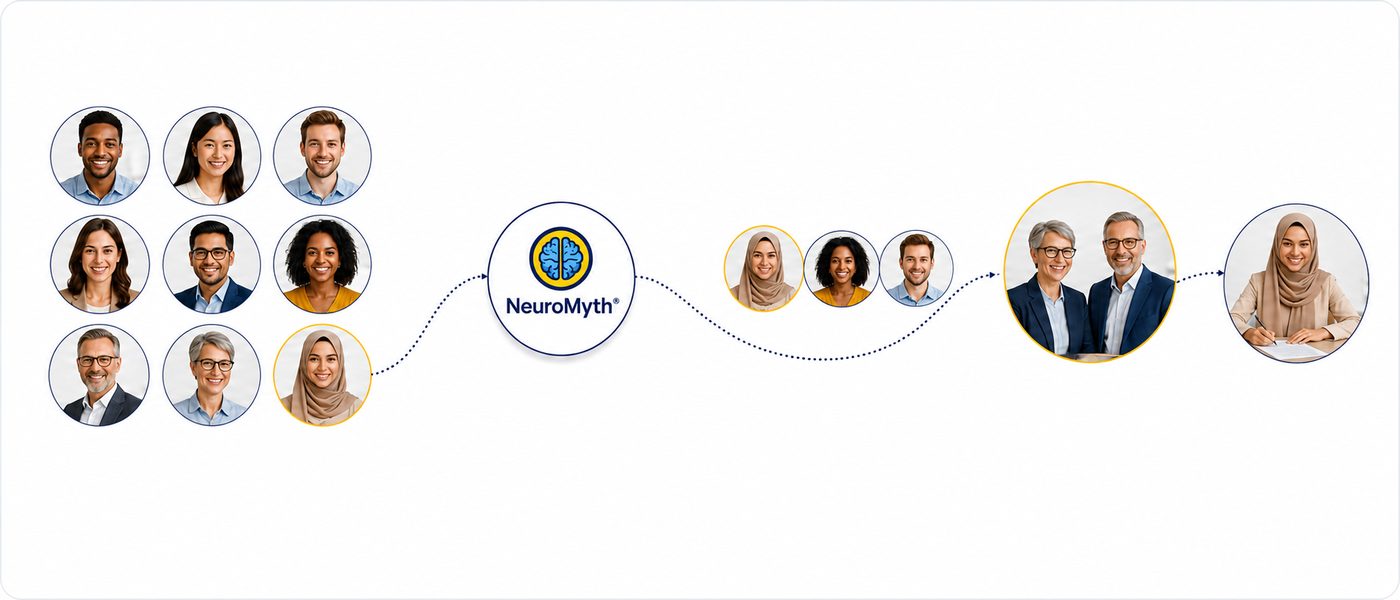
Handwriting, spelling, vocabulary, cultural references: none of these are measured. NeuroMyth reads how a story is structured — the same analysis regardless of who wrote it, where they come from, or how they present themselves.
Screen dozens of candidates with a consistent, uncoachable behavioral layer — delivered in hours, not days.
EXE and ELI depth levels reveal decision style, shadow risks, and stress patterns for high-stakes appointments.
Understand the motivational vectors that will shape your organization's culture before they do.
Five real assessments. Same system. Same human reviewer. Same output as paying clients. No sales call required.
Get 5 Free TRY →